
Get Ready For Your Language Test
Choose the best option for you of how to show your proficiency in English or French.
Here is the information that can answer all your questions!
Canadian citizens must show proficiency in one of Canada’s official languages: English and French. French is the first official language for approximately 23% of the population. Canadian Francophones live predominantly in Quebec, however, there are other French-speaking communities in Canada. English, consequently, is spoken by approximately 77% of the Canadian population.
To meet the language requirements for Canadian citizenship, you will need to prove your proficiency (understanding of basic grammar, proper use of verbs, etc.) in either English or French.
Article Navigation:
- Minimum age requirements & language test exemptions
- Skills that are tested for Canadian citizenship
- Approved Language Tests
- Language Certifications Accepted by the Canadian Government
- Government-Funded Courses for CLB4
- Citizenship Language Test Exemptions
- Are expired language tests accepted for Canadian citizenship?
- Why Your Language Proof Might Be Rejected?
Minimum and Maximum Age Requirements, Exemptions.
You will be required to prove your language proficiency if you are aged between 18 and 54 years old. All other ages are exempt from taking this test.
Skills That Are Tested for the Canadian Citizenship
Language requirements for Canadian citizenship are quite mild. You are only tested in speaking and listening. You don’t have to prove any other skills such as reading and writing.
Approved Language Tests
You have three options: IELTS (General), CELPIP (LS) and TEF. Let’s review each test in more detail.
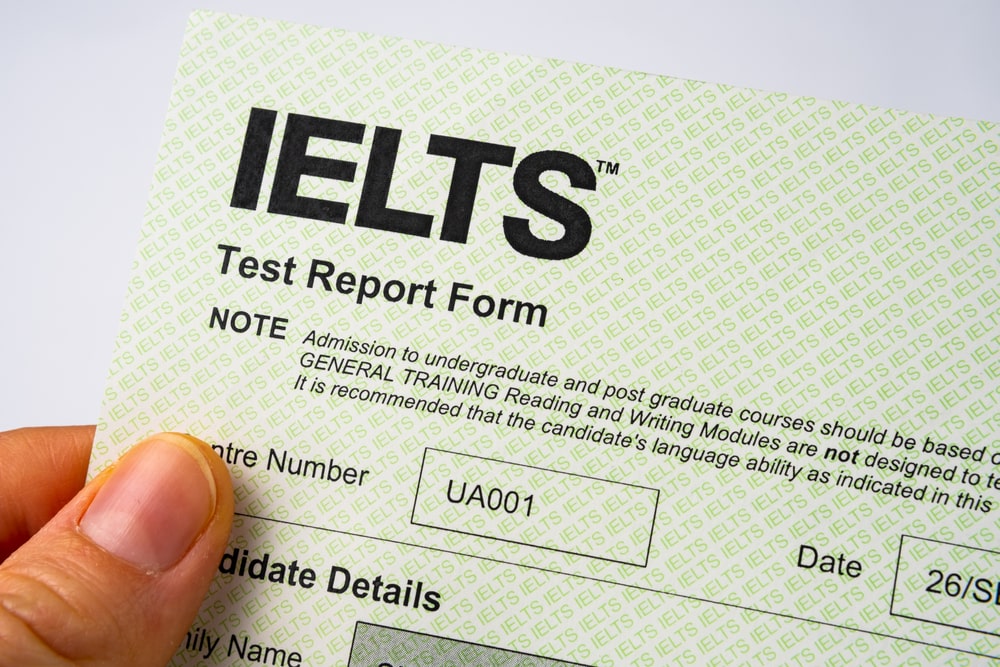
International English Language Testing System (IELTS)
Canadian English Language Proficiency Index Program (CELPIP)
There are two variations of the CELPIP tests: CELPIP-General and CELPIP-LS. LS stands for Listening & Speaking, which are exactly the skills that you need to show proficiency in for your citizenship. The minimum level to reach is CLB-4, which is the basic level of comprehension and speaking.
You can book your CELPIP-LS test online via this link.

Test d'Evaluation de Français (TEF)
Find the nearest testing center and book your test via this link.
If you have previously applied to any of the Quebec immigration programs, the following tests will also be accepted:
The certification offer consists of diplomas and tests: initial diploma in French language (DILF), (DELF), advanced diploma in French language (DALF), test of knowledge of French (TCF):
Language Certifications Accepted By The Canadian Government
If you attended a secondary or post-secondary program in English or French you may be exempt from taking a test. You will have to provide a copy of diploma, transcript and/or certificate.You can use certificates from your studies in English or French as proof of your language skills. For example, if you have a bachelor’s degree in Economics where all classes were in English, you can use that as proof of your language proficiency. If you studied at a French university and your program was entirely in French, you may also use that as proof of your French language ability.
Courses in other languages, even if they include English literature, will not be accepted. For example, if you studied English literature in a program where the main language of instruction was Spanish, that would not count. You can get degrees both in Canada and outside of Canada, but the degree program must be entirely in English or French to qualify. For instance, a law degree from an English-speaking university in Canada or an English-taught program abroad would be acceptable.
Government-Funded Courses to Achieve CLB4
One of the alternative methods is taking the following government-funded training courses:
- Language Instruction for Newcomers to Canada (LINC/CLIC): free English or French language courses for newcomers to Canada to help with daily life and work.
- ESL/FSL/CL: Ontario’s language training programs for immigrants to improve their English or French skills.
- Manitoba Adult English as an Additional Language (EAL) Program (Progress Report): a document showing progress in government-funded English language programs in Manitoba.
- Ministère de l’Immigration, de la Francisation et de l’Intégration (MIFI) or Ministère de l’Éducation, de l’Enseignement supérieur (MEES) : Quebec’s official framework for assessing French language proficiency.
- ELSA: free English classes in British Columbia for adult newcomers to improve communication and job readiness.
- Proficiency in English Nova Scotia (PENS) learner certificate.
After completing these training programs and getting certificates that demonstrate your proficiency in listening and speaking in either English or French, and which are CLB level 4 or higher, you may use these certificates to apply for Canadian Citizenship.
What Score Is Sufficient For Getting A Canadian Citizenship?
The Canadian Government has made it mandatory to score at least level 4 or higher points in Canadian Language Benchmark CLB4 in order to become eligible for Citizenship.
These are basic listening and speaking levels. Here is a useful table of equivalents for different language testing systems
What Are The Canadian Citizenship Language Test Exemptions?
If a person has a listening, speaking, psychiatric or psychological disorder that prevents him/her from being able to prove language ability, proof from Canadian medical authorities will be required to be exempt from testing.
Are Expired IELTS Test Results Accepted For Canadian Citizenship?
Yes, language tests for Canadian applications don’t have an expiration date and are accepted.
Formally, IELTS certifications are valid for 2 years, but that requirement only holds for purposes other than citizenship applications – getting a student visa, becoming a permanent resident etc.
Why Your Language Proof Might Be Rejected?
When proving you meet the language requirement for Canadian citizenship, be careful of these common mistakes:
- Wrong type of exam taken : if for example you have taken IELTS Academic instead of General.
- Wrong language: if your diploma or transcripts are not in English or French, they won’t be accepted, even if you studied in these languages.
- School verification: your diploma must come from a school that clearly teaches in English or French. If the school’s language of instruction is unclear, your proof may be rejected.
- Incomplete education: you must have finished your program and graduated. If you didn’t complete the degree, it doesn’t count.
- No confirmation of graduation: your transcripts must clearly show that you graduated.
- Individual courses don’t count: taking some classes in English or French is not enough. You must have a full high school, Bachelor’s, Master’s, or Ph.D. degree in one of these languages.
- Not all classes were in English or French: your entire program must have been in English or French. If some courses were in another language, your proof may not be accepted.
- Trade certificates don’t qualify: a Canadian trade certificate alone is not enough, as it may not prove high-level language skills.
Make sure your paperwork meets the requirements before applying. If your proof is missing or unclear, your application may be delayed or even rejected.
Frequently Asked Questions
For Canadian citizenship, you must have a CLB level of 4 or higher in listening and speaking.
Nope, you can use any of the alternatives, such as CELPIP or TEF.
For the purpose of citizenship applications, IELTS certificates don’t have an expiration date and are accepted as long as CLB4 is met.
Yes, the 6.5 score in IELTS is good enough for Canadian immigration. You can apply for immigration if you have scored 6 or above in IELTS.
No, TOEFL is not accepted by IRCC. You need to go with IELTS or CELPIP to become eligible for Citizenship in Canada.
If you cannot get proof from your school, you will need to take an approved language test to demonstrate your language ability.
No, applicants under 18 and those 55 or older do not need to provide proof. All other applicants must meet the language requirement.