
Express Entry
Everything you need to know about Express Entry. Discover eligibility requirements, CRS scoring, and the steps to becoming a permanent resident of Canada.
What is Express Entry?
Express Entry is an online system that was launched in 2015 by the Canadian government to manage applications from skilled workers. There are 3 main immigration programs managed through the Express Entry system:
First, you must find out if you are eligible for one of these programs.
In order to submit a profile for Express Entry Canada, you must meet the eligibility criteria for at least one of the three programs.
What is an Express Entry profile?
An Express Entry profile is an electronic form that you will submit to the Government of Canada including your personal details such as your work experience, age, educational background, language proficiency in either English or French, family details, and any ties you have to Canada.
With this information, your profile will be ranked against a pool of candidates in Canada’s Express Entry system.
What are the requirements to apply?
To be eligible in the Express Entry system, you will need to prove your education, skilled work experience, and language proficiency in English and/or French.
Each of the 3 Express Entry programs has different eligibility criteria, but in general, to be eligible to apply you should:
- Have completed post-secondary education that is assessed against Canadian standards
- Have at least 1 year continuous within the last 10 years (combination of part-time, full-time or more than 1 job) in your primary occupation.
- Completed your IELTS general training test, CELPIP test or TEF at a minimum Canadian Language Benchmark 7 (CLB 7). Note that to be competitive in the pool, we recommended scoring higher than a CLB 7 on your test to increase your overall points.
Once you meet these minimum eligibility requirements, your profile will be added to the Express Entry Canada pool. This does not guarantee that you will receive an invitation to apply for permanent residence in one of the rounds of invitations.
How much does Express Entry cost?
When applying for your Canadian Immigration, we understand the importance of having a realistic breakdown of the costs involved.
Note that applying for Express Entry is free. You will only have to pay for the following fees if you are invited to apply for permanent residence.
Below is a breakdown of the latest Express Entry application fees on the Government of Canada’s website as of now:
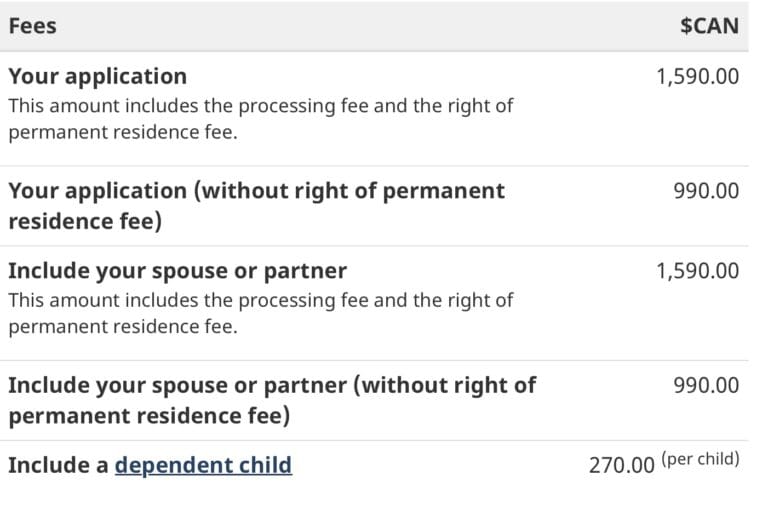
Other costs you should consider include:
- Biometrics Fee: $85 CAD per person up to $170 CAD per family.
- Medical Exams: Can range from $140-$400 CAD
- ECA Report/Educational Credential Assessment Fee (ECA): $200 -$270 CAD
- Police Clearance Certificates: Roughly $100
- Language Proficiency Test: $300 *Note that some test candidates need to take the exam more than once to achieve their desired band score.
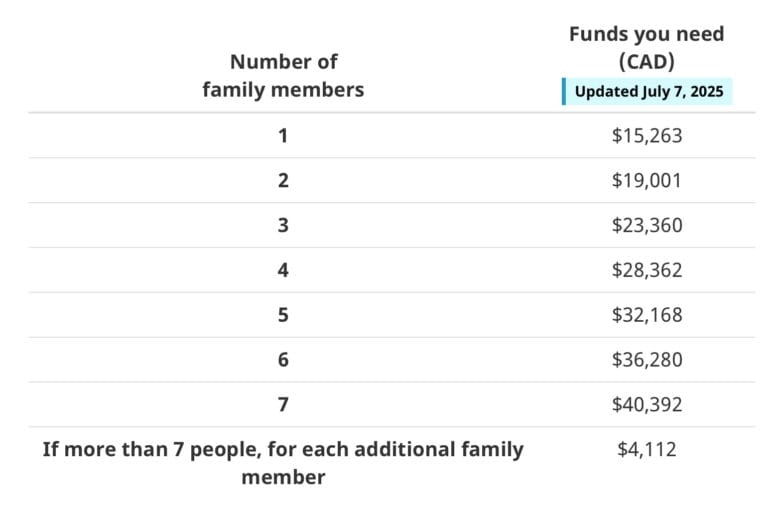
Additionally, unless you are applying for the Canadian Experience Class program (in other words, you already live in Canada), or you have an employment offer, you will also need to demonstrate proof of funds that you have enough money saved to support yourself during your resettlement in Canada. You do not have to pay these funds to the government but you do need to have easy access to it.
Below is the most recent table for the minimum amounts needed as of December 2023:
Need help with your Express Entry application?
Contact us and we’ll be happy to assist
How are Express Entry Points Calculated?
When you apply for Express Entry, your profile will be given a total number of points within what is called the Comprehensive Ranking System (CRS). Your points will be based on the following factors:
- Age
- Language Proficiency Level in English and/or French
- Level of education
- Canadian and foreign work experience
- Accompanying spouse or common law partner contributions
- Other connections to Canada
To find out your CRS score, you can use this Express Entry Calculator.
How to apply for Express Entry Canada
While you can apply for Express Entry on your own, there are a lot of documents that you will need to gather and steps to follow. You’ll find it helpful to have the support of a professional to guide you along the way.
The first step is to find out which program you are eligible for and if you meet the minimum eligibility criteria.
The second step is to calculate your express entry score, create your profile and have it ranked in the pool.
The third step is to gather your documents such as your language test results and education assessment.
Finally, you’ll submit your profile and wait to be invited to apply in the upcoming round of invitations for your permanent residency.
Once you create your profile in the Express Entry system, your profile will remain valid for up to 12 months. We cannot predict when you will receive your invitation to apply (ITA), but once you receive it, you will have 60 days to provide the required application documents.
After that, your permanent residency application can take as little as 6 months to process.
Are you eligible?
While there is no perfect score to be eligible within Express Entry, it is true that candidates with stronger profiles and higher points are more likely to get invited to apply for permanent residency.
In general, your profile will receive higher points if it meets the following requirements:
- Have at least 3 years of work experience
- Score at least a CLB 9 on your IELTS general training test, CELPIP, or TEF
- Have at least two Bachelor’s degrees or a Master’s degree
- Be under the age of 30
Is there a maximum age for Express Entry?
No. There is no age limit to apply for Express Entry. However, it is true that applicants between the ages of 20-29 receive the highest number of points for their age. After the age of 45, you no longer receive points towards your profile. That being said, there are other ways you can compensate for your age such as through your education.
What is the difference between being eligible and my CRS score?
The current pass mark for the Federal Skilled Worker Program is 67 points out of a 100. These points are different from the points used to rank your profile in the Express Entry pool. Once you are in the Express Entry pool, you will receive a CRS score. The Government of Canada will then rank candidates in the pool and invite those with the highest CRS scores to apply for permanent residence.
What’s the minimum score to be invited?
The minimum Express Entry CRS score to be invited varies from draw to draw and from program to program. No one can predict what the next draw will be. Your best bet is to be prepared by having the most CRS points in your Express Entry profile.
Do I need to speak English or French?
Yes. While each Express Entry program has different eligibility criteria, it’s best to be prepared to pass your language test with a minimum of a Canadian Language Benchmark (CLB) 7. This is equivalent to intermediate level proficiency B1 on the CEFR scale.
The Canadian Language Benchmark (CLB) you will need will depend on the program you are applying for.
For example, if you are applying for the Federal Skilled Worker Class Program, you must score at least a Canadian Language Benchmark (CLB) 7 on your exam (equivalent to intermediate level proficiency).
But for the Canadian Experience Class Program, you can qualify with a CLB 5, still within the Intermediate range but on the lower end of it, if your job is TEER 2 or 3.
That being said, we strongly suggest scoring a CLB 9 or higher as this can get you up to an additional 60 CRS points for your profile.
Learn more about the language requirements for Express Entry.
Need guidance with Express Entry?
Contact us and we’ll be happy to assist
What is an Express Entry draw?
Periodically, the Government of Canada announces an Express Entry Draw in which candidates that have been waiting in the pool and that meet the CRS points cut off are invited to apply.
The draws vary depending on the program and cannot be predicted by any lawyer or registered Canadian immigration consultant. If you receive an invitation to apply, meaning your profile has enough points in the Express Entry Pool, you may apply for your Canadian permanent residency.
Your best bet is to be prepared by having your profile created in Canada’s Express Entry Pool and to explore all of your pathways for immigration.
What types of draws should I expect?
Picture the Express Entry program like an umbrella that manages several other programs. Canada’s Express Entry program is the federal program and within it there are other opportunities for you to consider. This is great news!
As you pay attention to the news, you may see a mix of draws broken down as follows:
- Draws classified as “General” or “All Programs” include candidates that are in the Express Entry Pool and that are eligible for 1 of the 3 main EE programs: Canadian Experience Class, Federal Skilled Worker, Federal Skilled Trades Program.
- Draws classified as “Program-specific” invite top candidates that qualify for specific programs like the Provincial Nominee Program.
- Draws classified as “category-based” invite candidates in the Express Entry pool who are eligible for a specific category established by the Minister to meet an identified economic goal through Category-Based Selection.
Why have the Express Entry draws been so high?
Since Canada has been internationally recognized as having an excellent quality of life and a welcoming immigration program, people from all over the world are applying for Express Entry.
The reality is that candidates in the Express Entry system are now highly skilled and experienced, making the pool much more competitive.
Simply put, the more hopeful immigrants waiting in the pool, the higher the draws.
Will the draws go down?
There is no way to predict when or if the current CRS draws will go down. We understand how stressful or frustrating this can be. However, we also recognize that there are other pathways for immigration such as through Provincial Nominee Programs (PNP) that can give you an additional 600 CRS points.
Provincial nominations are designed to fill local labour or demographic gaps in provinces, which means that you still have the opportunity to get your permanent residency in Canada even if you currently have a low CRS score.
Need help with your Express Entry application?
Contact us and we’ll be happy to assist
Why your language score is important
Since Canada is a bilingual country, you must prove your language proficiency in either English or French. There are 3 different tests that you can take to prove your language proficiency. For English, you can take either the IELTS General Training test or the CELPIP test. For French, you can take the TEF exam.
The Canadian Language Benchmark (CLB) you will need will depend on the program you are applying for.
For example, if you are applying for the Federal Skilled Worker Class Program, you must score at least a Canadian Language Benchmark (CLB) 7 on your exam. This is equivalent to intermediate level proficiency (B1) on the CEFR scale.
But for the Canadian Experience Class Program, you can qualify with a CLB 5, still within the Intermediate range but on the lower end of it, if your job is TEER 2 or 3.
That being said, we strongly suggest scoring a CLB 9 or higher as this can get you up to an additional 60 CRS points for your profile.
Learn more about the language requirements for Express Entry.
Do my spouse or common-law partner need to prove their language proficiency?
Your accompanying spouse or common-law partner may also need to take a language exam such as the IELTS or CELPIP test depending on your score if you are applying through the Federal Skilled Worker Program. If they score a minimum of a CLB 5 on their exam, which is equivalent to pre-intermediate proficiency level, you can get an extra 4 points towards your score.
Why is my Express Entry score zero?
If your Express Entry profile is at zero, that means your profile did not meet the eligibility criteria upon creating it or something has changed after it has been in the pool for some time.
Common reasons why this can happen is:
- You no longer meet the minimum proof of funds requirements
- Your language test results expired. Language test results expire after 2 years.
- Losing eligibility points as you age
- No longer meeting work experience requirements for the given program you are applying for
- Having less than 1 year of work experience in your NOC code
How will a job offer affect my Express Entry profile?
You do not need to have a Canadian job offer to create your Express Entry profile.
Can I apply to Express Entry without work experience?
No. Every program within Canada’s Express Entry requires a minimum of at least 1 year of skilled work experience.
What is the NOC? (National Occupation Classification)
The Government of Canada uses the 2021 National Occupational Classification (NOC) system to identify and categorize jobs (occupations) based on the Training, Education, Experience and Responsibilities (TEER) they require.
When you create your Express Entry Profile, your occupation will have a specific NOC.
Find your job title, code, and TEER here.
Need guidance with Express Entry?
Contact us and we’ll be happy to assist
All About Provincial Nominee Programs
Did you know that there are other pathways for you to get your permanent residency in Canada other than through the Express Entry system?
The Provincial Nominee Programs have been designed to fill in labour and demographic gaps in the provinces and territories across Canada and have given hope to many of our clients.
Provincial Nominee Programs (PNP) or Express Entry?
If your current CRS points are low and are not enough to be invited in the federal draws, a Provincial Nominee Program may be an option as you will receive an additional 600 CRS points added to your profile.
You can apply to both programs at the same time so doing so will only increase your chances of getting invited in the next round of invitations.
Can I apply for a Provincial Nominee Program and Canada’s Express Entry at the same time?
Yes, you can. If you apply for a PNP, you will eventually need to apply to the federal government for your permanent residence application.
There are two different types of PNP applications: base and enhanced.
Provincial and territorial nominations made through the paper-based process outside of Express Entry are called “base nominations” and are subject to existing PNP streams and processing standards.
Provincial and territorial nominations made via Express Entry are called “enhanced nominations” and enable each province and territory to increase its annual nomination space. Enhanced nominations are processed online and processing times are usually 6 months or less (in 80% of cases).
If you receive a nomination under an enhanced PNP, your profile could receive an additional 600 CRS points.
On Your Side
After learning all about the Express Entry system, you might be feeling a mixture of excitement and overwhelm. Excited because of all of the opportunities you have in front of you to finally start your new life in Canada, but also a little bit overwhelmed. It’s okay. That’s normal.
We know it’s a lot of information, but our team here at LIVIN Immigration Services understands just how stressful it can be to apply for Express Entry without the help of experienced and professional legal help.
The good news is you do not have to do it alone.